363 Complex Conjugate
A mapping that maps a complex number to its conjugate value that is used to form real norms from complex scalars.
Complex conjugation of complex numbers produces real, non-negative values. This is useful for measuring lengths in complex vector spaces, such as Hilbert spaces. Complex conjugation can be applied to both complex numbers and complex vectors.
definition [d] (Complex Conjugate = Conjugate) A map \(\;\bar{\;\cdot\;}: \mathbb{C} \rightarrow \mathbb{C}\) that flips the imaginary part of a complex number:
- \(\overline{a + bi} = a - bi\) .
where
- \(a, b \in \mathbb{R}\).
- \(i\) is the imaginary unit, \(i^2 = -1\).
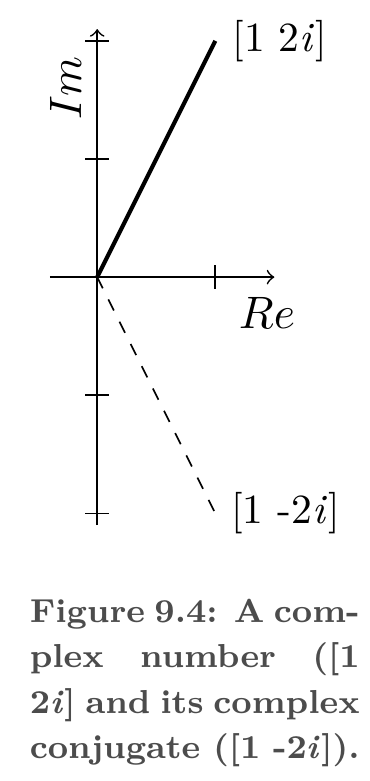
Geometric interpretation of the complex conjugate: reflecting a complex number across the real axis in the complex plane.
363.1 Examples
363.2 References
- Arfken, G. B., Weber, H. J., & Harris, F. E. Mathematical Methods for Physicists, 7th ed. Elsevier / Academic Press, 2013. — definition.
- Cohen, M. X. Linear Algebra: Theory, Intuition, Code. Sincxpress BV, 2021. — definition; Figure 9.4, p. 245.
- Adjoint
- Basis
- Characteristic Polynomial
- Complex Conjugate
- Conjugate Symmetry
- Conjugate Transpose
- Determinant
- Diag
- Dual Space
- Eigendecomposition
- Eigenvalue
- Eigenvector
- Hermitian
- Hermitian Conjugate
- Homogeneity
- Homogeneous
- Inner Product
- Inner Product Space
- Kronecker Delta
- Linear Function
- Linear Map
- Linear Transformation
- Operator
- Orthonormal
- Orthonormal Set of Functions
- Projection Map
- Quadratic
- Standard Basis