275 Exterior Algebra and Exterior Derivatives
Exterior algebra and exterior differentiation extend linear algebra and calculus for manifolds. Exterior algebra is the algebra of alternating tensors; exterior differentiation is the differentiation of differential forms—which assign alternating multilinear functions to points on manifolds.
It is required to extend linear algebra and calculus for manifolds because manifolds are only locally Euclidean. That is to say, Euclidean geometric axioms apply only to local regions of a manifold.
Consider Figure 1.
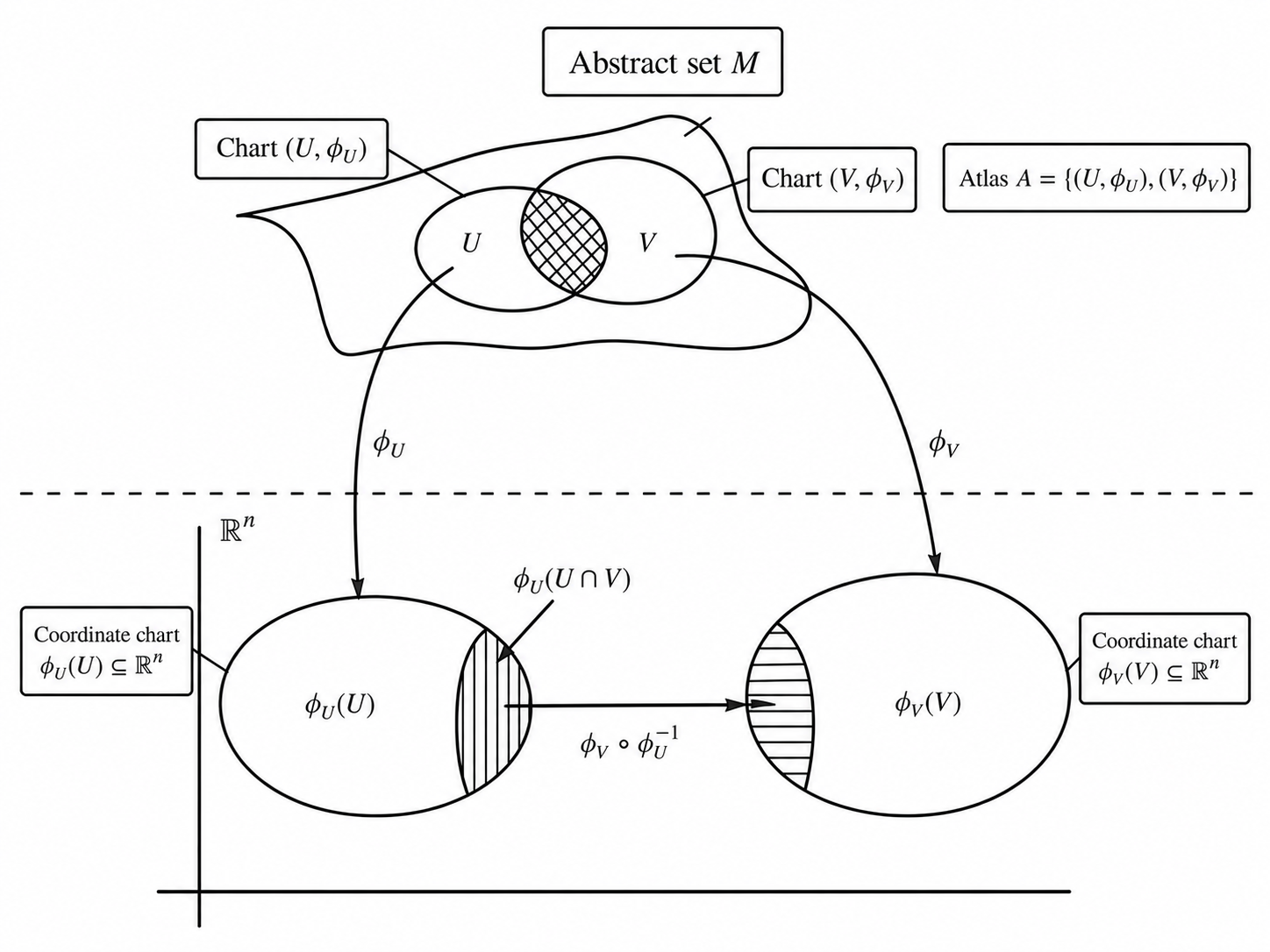
Exterior dertivatives are differential operators.
275.1 Examples
275.1.1 Simple
The exterior product of two basis covectors is a \(2\)-form that changes sign under a swap of vector inputs.
\[ \{ e^{1},\ e^{2} \} \]
\[ e^{1} \wedge e^{2} \]
\[ (e^{1} \wedge e^{2})(e_{1},e_{2}) = 1,\quad (e^{1} \wedge e^{2})(e_{2},e_{1}) = -1 \]
where
- \(e^{1}, e^{2}\) are basis covectors.
- \(\wedge\) is the exterior product.
- \(e_{1}, e_{2}\) are dual basis vectors.
275.1.2 General
In three dimensions the exterior algebra includes \(1\)-forms and \(2\)-forms among three covectors, and \(d\) raises degree by one.
\[ \{ e^{1},\ e^{2},\ e^{3} \} \]
\[ e^{1} \wedge e^{2},\quad e^{1} \wedge e^{3},\quad e^{2} \wedge e^{3} \]
\[ \text{if } f = x^{1},\quad df = e^{1} \]
where
- \(df\) is the exterior derivative of the function \(f\).
- \(e^{1} \wedge e^{2}\) is a basis \(2\)-form in \(\mathbb{R}^{3}\).
- Alternating Function
- Alternating k-linear function
- Boundary Operation
- Bundle
- Cartesian Product
- Constant Metric Tensor
- Contravariant Rank
- Covariant Rank
- Covariant, Contravariant, and Coordinate Systems
- Differential Forms
- Differential k-Form
- Edge of a Domain
- Exterior Algebra and Exterior Derivatives
- Forms
- Functions
- Inverse Metric
- k-Covector
- k-Covector Field
- k-Fold Product
- k-form
- k-Tensor
- Lie
- Lie Algebra
- Line Element
- Linear Functional
- Lorentzian Manifold
- Metric Tensor
- Multilinear Function
- Nondegenerate
- Nondegenerate Bilinear Form
- One-Form
- Smooth
- Smooth Assignment
- Smooth Mapping
- Stoke’s Theorem and the Fundamental Theorem of Calculus
- Symmetric Array
- Tangent Space
- Tensor Field
- Tensors
- Two-Form
- Type-(0,2) Tensor Field
- Type-(q,r) Tensor