311 Derivation of Curl
\(\displaystyle \operatorname{curl} \mathbf{F} = \nabla \times \mathbf{F} = \begin{vmatrix} \mathbf{i} & \mathbf{j} & \mathbf{k} \\ \dfrac{\partial}{\partial x} & \dfrac{\partial}{\partial y} & \dfrac{\partial}{\partial z} \\ F_{x} & F_{y} & F_{z} \end{vmatrix}\)
Vector Field. Let
\[ \mathbf{F} = F_x\mathbf{i} + F_y\mathbf{j} + F_z\mathbf{k} \]
where
- \(\mathbf{F}\) is a vector field.
- \(F_x\) is the \(x\)-component of \(\mathbf{F}\).
- \(F_y\) is the \(y\)-component of \(\mathbf{F}\).
- \(F_z\) is the \(z\)-component of \(\mathbf{F}\).
- \(\mathbf{i}\) is the unit vector along \(x\).
- \(\mathbf{j}\) is the unit vector along \(y\).
- \(\mathbf{k}\) is the unit vector along \(z\).
Differential Components. Define
\[ X = \frac{\partial F_z}{\partial y} - \frac{\partial F_y}{\partial z} \]
\[ Y = \frac{\partial F_x}{\partial z} - \frac{\partial F_z}{\partial x} \]
\[ Z = \frac{\partial F_y}{\partial x} - \frac{\partial F_x}{\partial y} \]
where
- \(X\) is the differential component along \(x\).
- \(Y\) is the differential component along \(y\).
- \(Z\) is the differential component along \(z\).
- \(x\), \(y\), \(z\) are Cartesian coordinates.
- \(\partial\) denotes partial differentiation.
These quantities transform together as Cartesian vector components. Therefore,
\[ \mathbf{R} = X\mathbf{i} + Y\mathbf{j} + Z\mathbf{k} \]
where
- \(\mathbf{R}\) is the resulting vector field.
- \(X\), \(Y\), \(Z\) are its Cartesian components.
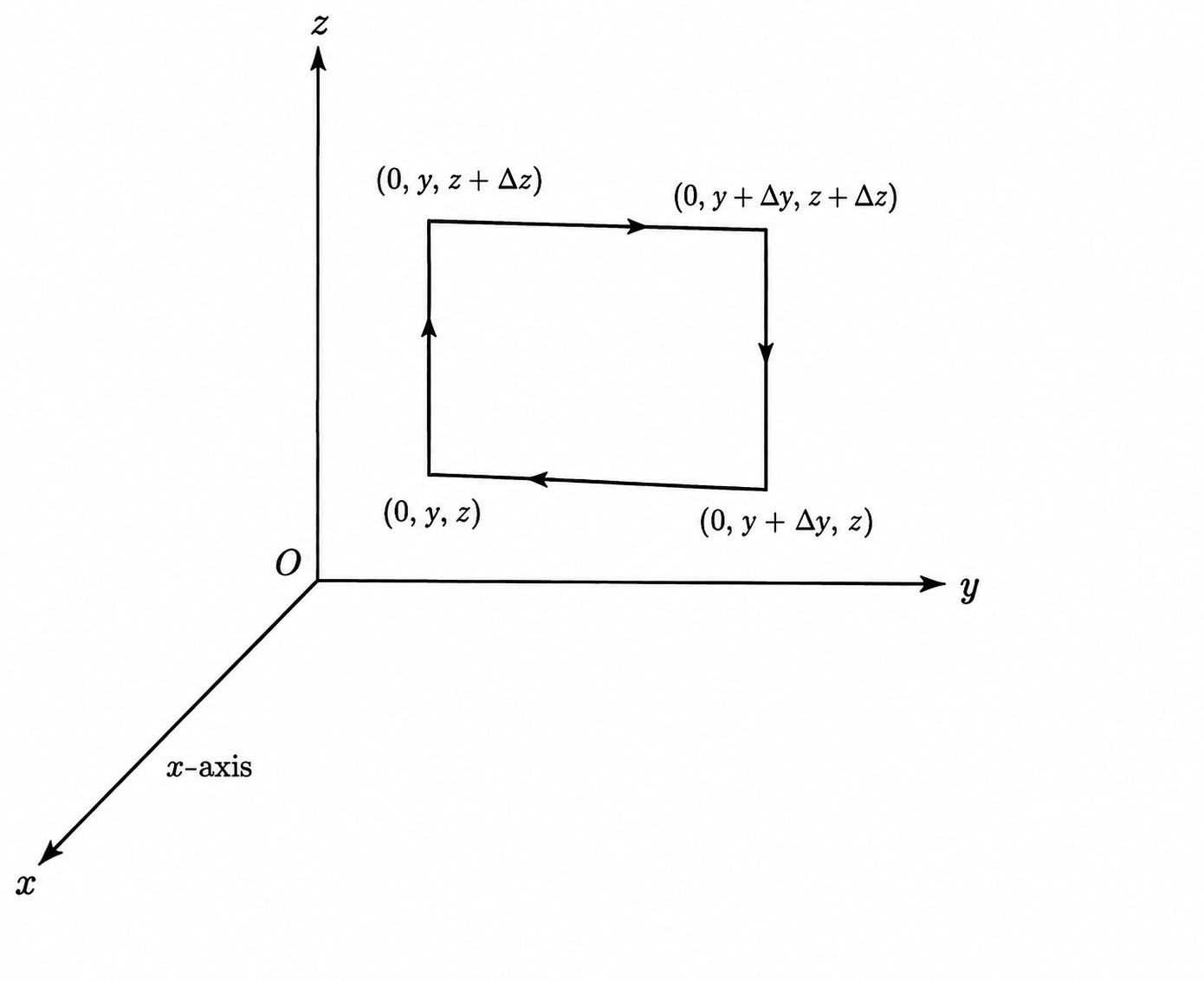
Substituting the differential components gives
\[ \mathbf{R} = \left( \frac{\partial F_z}{\partial y} - \frac{\partial F_y}{\partial z} \right)\mathbf{i} + \left( \frac{\partial F_x}{\partial z} - \frac{\partial F_z}{\partial x} \right)\mathbf{j} + \left( \frac{\partial F_y}{\partial x} - \frac{\partial F_x}{\partial y} \right)\mathbf{k} \]
where
- \(\mathbf{i}\) gives the \(x\) direction.
- \(\mathbf{j}\) gives the \(y\) direction.
- \(\mathbf{k}\) gives the \(z\) direction.
Curl. This vector is the curl of \(\mathbf{F}\):
\[ \operatorname{curl}\mathbf{F} = \left( \frac{\partial F_z}{\partial y} - \frac{\partial F_y}{\partial z} \right)\mathbf{i} + \left( \frac{\partial F_x}{\partial z} - \frac{\partial F_z}{\partial x} \right)\mathbf{j} + \left( \frac{\partial F_y}{\partial x} - \frac{\partial F_x}{\partial y} \right)\mathbf{k} \]
where
- \(\operatorname{curl}\mathbf{F}\) is the curl of \(\mathbf{F}\).
- Each coefficient is a Cartesian curl component.
Thus,
\[ (\operatorname{curl}\mathbf{F})_x = \frac{\partial F_z}{\partial y} - \frac{\partial F_y}{\partial z} \]
\[ (\operatorname{curl}\mathbf{F})_y = \frac{\partial F_x}{\partial z} - \frac{\partial F_z}{\partial x} \]
\[ (\operatorname{curl}\mathbf{F})_z = \frac{\partial F_y}{\partial x} - \frac{\partial F_x}{\partial y} \]
where
- \((\operatorname{curl}\mathbf{F})_x\) is the \(x\)-component.
- \((\operatorname{curl}\mathbf{F})_y\) is the \(y\)-component.
- \((\operatorname{curl}\mathbf{F})_z\) is the \(z\)-component.
Cross Product. For
\[ \mathbf{a} = a_1\mathbf{i} + a_2\mathbf{j} + a_3\mathbf{k} \]
and
\[ \mathbf{b} = b_1\mathbf{i} + b_2\mathbf{j} + b_3\mathbf{k} \]
where
- \(\mathbf{a}\) is the first vector.
- \(\mathbf{b}\) is the second vector.
- \(a_1\), \(a_2\), \(a_3\) are components of \(\mathbf{a}\).
- \(b_1\), \(b_2\), \(b_3\) are components of \(\mathbf{b}\).
The cross product is
\[ \mathbf{a}\times\mathbf{b} = (a_2b_3-a_3b_2)\mathbf{i} + (a_3b_1-a_1b_3)\mathbf{j} + (a_1b_2-a_2b_1)\mathbf{k} \]
where
- \(\mathbf{a}\times\mathbf{b}\) is the cross product.
- Each coefficient is a Cartesian component.
Differential Operator. Define
\[ \nabla = \mathbf{i}\frac{\partial}{\partial x} + \mathbf{j}\frac{\partial}{\partial y} + \mathbf{k}\frac{\partial}{\partial z} \]
where
- \(\nabla\) is the vector differential operator.
- \(\dfrac{\partial}{\partial x}\) differentiates with respect to \(x\).
- \(\dfrac{\partial}{\partial y}\) differentiates with respect to \(y\).
- \(\dfrac{\partial}{\partial z}\) differentiates with respect to \(z\).
Set
\[ \mathbf{a}=\nabla \]
and
\[ \mathbf{b}=\mathbf{F}. \]
The cross-product rule gives
\[ \nabla\times\mathbf{F} = \left( \frac{\partial F_z}{\partial y} - \frac{\partial F_y}{\partial z} \right)\mathbf{i} + \left( \frac{\partial F_x}{\partial z} - \frac{\partial F_z}{\partial x} \right)\mathbf{j} + \left( \frac{\partial F_y}{\partial x} - \frac{\partial F_x}{\partial y} \right)\mathbf{k} \]
where
- \(\nabla\) supplies the differential operators.
- \(\mathbf{F}\) supplies the field components.
- \(\times\) applies the cross-product rule.
Comparing with the component form,
\[ \operatorname{curl}\mathbf{F} = \nabla\times\mathbf{F}. \]
Determinant Form. The ordinary cross product may be written
\[ \mathbf{a}\times\mathbf{b} = \begin{vmatrix} \mathbf{i} & \mathbf{j} & \mathbf{k} \\ a_1 & a_2 & a_3 \\ b_1 & b_2 & b_3 \end{vmatrix} \]
where
- The first row contains Cartesian unit vectors.
- The second row contains \(\mathbf{a}\) components.
- The third row contains \(\mathbf{b}\) components.
Replacing \(\mathbf{a}\) by \(\nabla\) and \(\mathbf{b}\) by \(\mathbf{F}\) gives
\[ \nabla\times\mathbf{F} = \begin{vmatrix} \mathbf{i} & \mathbf{j} & \mathbf{k} \\ \dfrac{\partial}{\partial x} & \dfrac{\partial}{\partial y} & \dfrac{\partial}{\partial z} \\ F_x & F_y & F_z \end{vmatrix} \]
where
- The first row contains Cartesian unit vectors.
- The second row contains differential operators.
- The third row contains field components.
- The determinant is symbolic.
Expanding the determinant,
\[ \nabla\times\mathbf{F} = \mathbf{i} \begin{vmatrix} \dfrac{\partial}{\partial y} & \dfrac{\partial}{\partial z} \\ F_y & F_z \end{vmatrix} - \mathbf{j} \begin{vmatrix} \dfrac{\partial}{\partial x} & \dfrac{\partial}{\partial z} \\ F_x & F_z \end{vmatrix} + \mathbf{k} \begin{vmatrix} \dfrac{\partial}{\partial x} & \dfrac{\partial}{\partial y} \\ F_x & F_y \end{vmatrix}. \]
Evaluating the minors gives
\[ \nabla\times\mathbf{F} = \left( \frac{\partial F_z}{\partial y} - \frac{\partial F_y}{\partial z} \right)\mathbf{i} - \left( \frac{\partial F_z}{\partial x} - \frac{\partial F_x}{\partial z} \right)\mathbf{j} + \left( \frac{\partial F_y}{\partial x} - \frac{\partial F_x}{\partial y} \right)\mathbf{k}. \]
Rearranging the \(y\)-component,
\[ \nabla\times\mathbf{F} = \left( \frac{\partial F_z}{\partial y} - \frac{\partial F_y}{\partial z} \right)\mathbf{i} + \left( \frac{\partial F_x}{\partial z} - \frac{\partial F_z}{\partial x} \right)\mathbf{j} + \left( \frac{\partial F_y}{\partial x} - \frac{\partial F_x}{\partial y} \right)\mathbf{k}. \]
Hence,
\(\displaystyle \operatorname{curl} \mathbf{F} = \nabla \times \mathbf{F} = \begin{vmatrix} \mathbf{i} & \mathbf{j} & \mathbf{k} \\ \dfrac{\partial}{\partial x} & \dfrac{\partial}{\partial y} & \dfrac{\partial}{\partial z} \\ F_{x} & F_{y} & F_{z} \end{vmatrix}\)
311.1 References
MacCullagh, J. An Essay towards a Dynamical Theory of Crystalline Reflexion and Refraction. Transactions of the Royal Irish Academy, Vol. XXI. Read 9 December 1839; published 1846.
Lunney, J. G. James MacCullagh. Trinity College Dublin, 2015.
Kreyszig, E. Advanced Engineering Mathematics, 10th ed. Wiley, 2011.
Riley, K. F., Hobson, M. P., & Bence, S. J. Mathematical Methods for Physics and Engineering.
- Basic Derivation of Jacobian
- Chain Rule
- Cross Product
- Curl
- Curve
- Definite Integral
- Derivation of Curl
- Derivation of Divergence
- Derivation of Grad
- Derivation of Jacobian
- Derivation of Taylor Expansion
- Divergence
- Dot Product
- Envelope of Tangent Lines
- General Functions
- Gradient
- Improper Integral
- Indefinite Integral
- Jacobian
- Legendre Transform
- Legendre Transform Derivation
- Limit
- Line Integral
- Notes
- Parameterization
- Partial Derivative
- Real Parameter
- Scalar Projection
- Smooth Curve
- Vector Calculus
- Vector Differential Operator
- Vector Field
- Vector Projection