329 Parameterization
A function that labels points of a curve by a real parameter that is used to write coordinates along the curve.
An implicit equation gives a constraint on points; parameterization instead gives a rule that generates each point on the curve.
For example:
\[ x^2+y^2=1 \]
versus \[ x=\cos t,\qquad y=\sin t.\]
The first describes which points belong to the circle. The second tells you how to move through those points.
definition [d] (Parameterization = Parametrization = Parametric Representation) A continuous vector-valued function that traces a curve \(C\) as the parameter varies over an interval \(I\):
- \(\mathbf{r}(t) = \langle f(t),\, g(t),\, h(t) \rangle\) , \(t \in I\) .
where
- \(\mathbf{r}(t)\) is the position vector of a point on \(C\).
- \(C\) is the curve being traced.
- \(f, g, h\) are continuous real-valued functions on \(I\).
- \(t\) is the parameter.
- \(I\) is the parameter interval.
Note:
- a given curve admits many different parameterizations; speed and direction may differ.
definition [d] (Parameterization = Parametrization = Parametric Form) A description of a curve by expressing its coordinates as continuous functions of a single parameter \(t \in I\):
- \(x = f(t)\), \(y = g(t)\), \(z = h(t)\) .
where
- \(f, g, h\) are continuous real-valued functions on \(I\).
- \(t\) is the parameter.
- \(I\) is the parameter interval.
- \(x, y, z\) are coordinates of a point on the curve.
Note:
- as \(t\) increases, the point \((f(t), g(t), h(t))\) moves along the curve with a definite orientation.
329.1 Examples
329.1.1 Simple
A line in the plane labeled by three parameter values.
\[ \mathbf{r} : I \rightarrow \mathbb{R}^{2} \]
\[ I = \{ 0,\ 1,\ 2 \} \]
\[ \mathbf{r}(t) = \langle t,\ 2t \rangle \]
\[ \mathbf{r}(0) = \langle 0,\ 0 \rangle,\quad \mathbf{r}(1) = \langle 1,\ 2 \rangle,\quad \mathbf{r}(2) = \langle 2,\ 4 \rangle \]
where
- \(\mathbf{r}\) is the parameterization.
- \(I\) is the set of parameter values.
- \(t\) is the parameter.
329.1.2 General
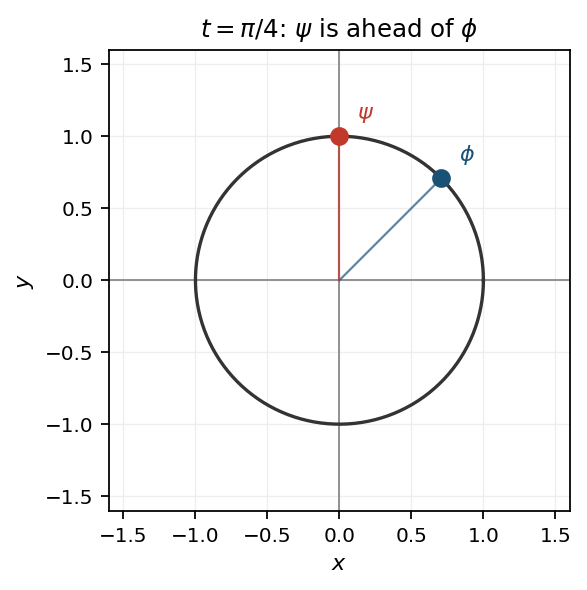
A unit circle in the plane labeled by a continuous parameter, with sample points and a second parameterization of the same curve.
\[ \phi : [0, 2\pi) \rightarrow \mathbb{R}^{2} \]
\[ \phi(t) = \langle \cos t,\ \sin t \rangle \]
\[ x = \cos t,\quad y = \sin t \]
\[ \phi(0) = \langle 1,\ 0 \rangle,\quad \phi\!\left(\dfrac{\pi}{2}\right) = \langle 0,\ 1 \rangle,\quad \phi(\pi) = \langle -1,\ 0 \rangle \]
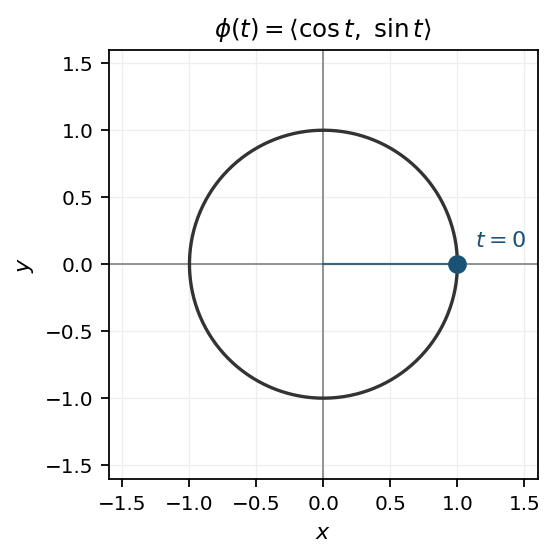
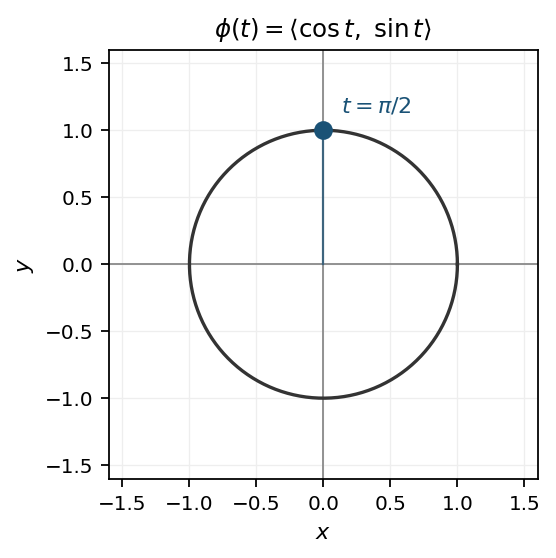
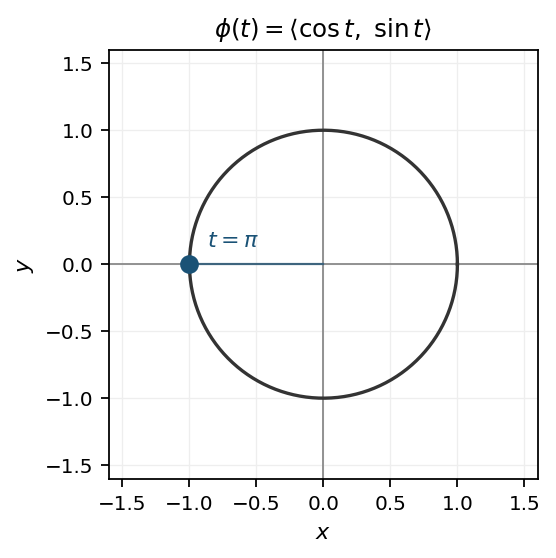
The same circle admits another parameterization that traverses it twice as fast. Every point on the unit circle still has the form \(\langle \cos\theta,\ \sin\theta \rangle\) for some angle \(\theta\).
\[ \psi : [0, \pi) \rightarrow \mathbb{R}^{2} \]
To finish one full lap while \(t\) runs only through \([0, \pi)\), the angle must advance twice as fast, so \(\theta = 2t\). Substituting that angle into the same cosine and sine form gives
\[ \psi(t) = \langle \cos 2t,\ \sin 2t \rangle \]
so \(\phi\) and \(\psi\) share the same image while differing in speed. At the same parameter value \(t=\pi/4\), the point \(\psi(t)\) has already advanced farther around the circle than \(\phi(t)\).
where
- \(\phi\) is a parameterization of the unit circle.
- \(\psi\) is another parameterization of the same circle.
- \(t\) is the parameter.
- \(\theta\) is the angle used inside cosine and sine.
- \([0, 2\pi)\) and \([0, \pi)\) are the parameter intervals.
- \(x\) and \(y\) are coordinates of a point on the curve.
- the image of \(\phi\) and of \(\psi\) is the circle of radius \(1\).
329.2 References
- Stewart, J. Calculus. — parametrization via \(\mathbf{r}(t)\) and parametric equations \(x=f(t)\), \(y=g(t)\), \(z=h(t)\).
- Bachman, D. A Geometric Approach to Differential Forms. Birkhäuser, 2012. — \(\phi(t)=(\cos t,\sin t)\) for \(0\leq t<2\pi\); also \(\psi(t)=(\cos 2t,\sin 2t)\) for the same circle at twice the speed.
- Basic Derivation of Jacobian
- Chain Rule
- Cross Product
- Curl
- Curve
- Definite Integral
- Derivation of Curl
- Derivation of Divergence
- Derivation of Grad
- Derivation of Jacobian
- Derivation of Taylor Expansion
- Divergence
- Dot Product
- Envelope of Tangent Lines
- General Functions
- Gradient
- Improper Integral
- Indefinite Integral
- Jacobian
- Legendre Transform
- Legendre Transform Derivation
- Limit
- Line Integral
- Notes
- Parameterization
- Partial Derivative
- Real Parameter
- Scalar Projection
- Smooth Curve
- Vector Calculus
- Vector Differential Operator
- Vector Field
- Vector Projection